

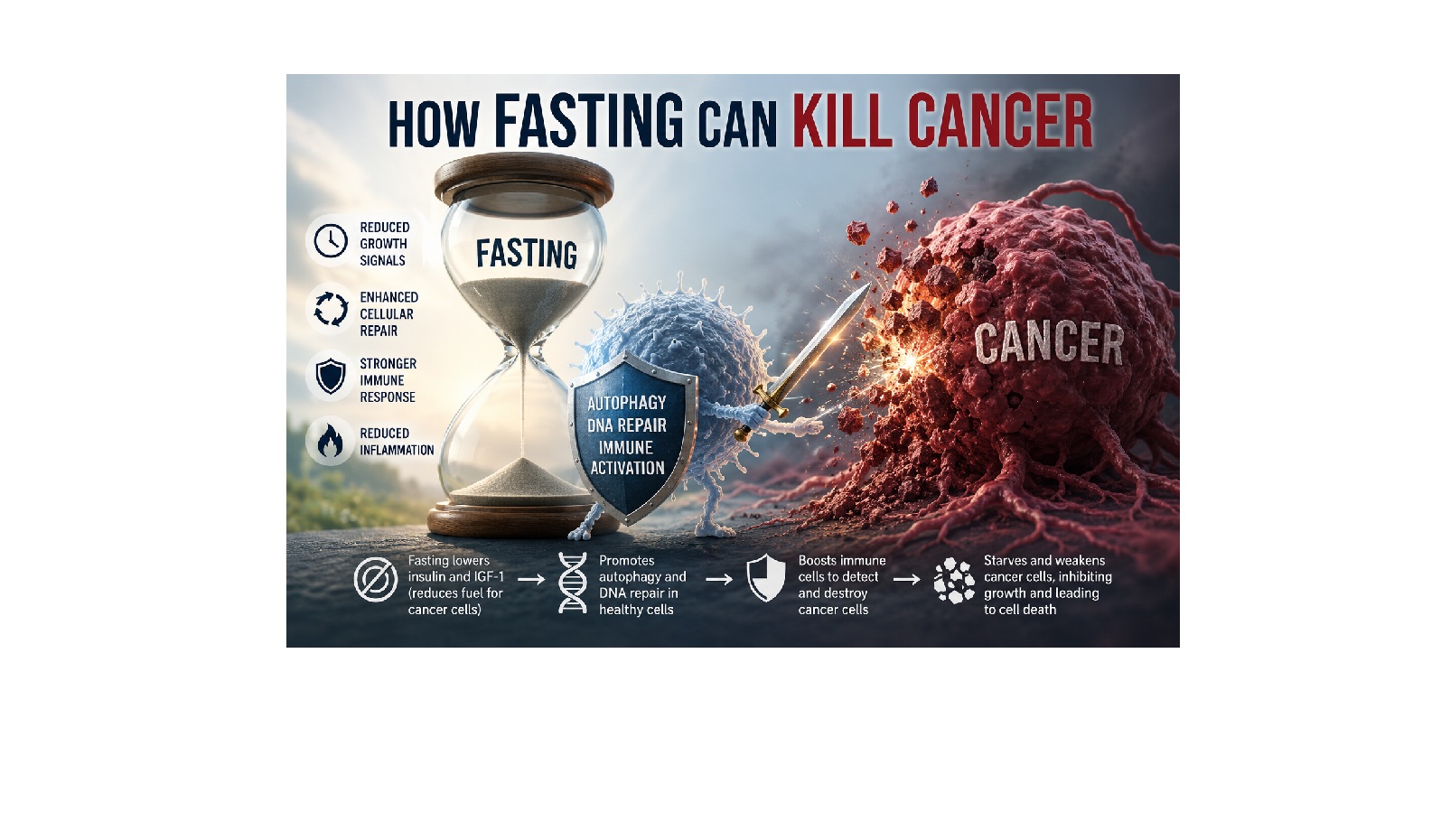
Fasting: A Powerful Anti-Cancer Tool
The following is the lead-in to an Unbekoming Substack article on the incredible power of fasting in treating cancer:
The Body Is Its Own Surgeon
Herbert Shelton supervised more than thirty thousand fasts at his Natural Hygiene centers across four decades of clinical practice. What he documented across those decades has no place in conventional oncology and is therefore not discussed in oncology offices. When a person stops eating, the body selectively dismantles its own tissue, and it begins with the tissue it does not need. Fat reserves are consumed first. The body then begins to clear what it has been carrying without anatomical purpose: cysts, fibroids, tumors, arterial deposits, scar accumulations. Vital organs are protected until the very end. The body, given no food, performs surgery on itself, and the surgery is more precise than any external scalpel because the body knows what to keep.¹
Shelton called the process autolysis, meaning enzymatic self-digestion under conditions of voluntary food abstention. He observed fibroid tumors dissolve while the uterus housing them remained intact. He watched arthritic deposits clear while bone and muscle stayed strong. He documented hearts that grew stronger, not weaker, across fasts of two and three weeks. The dismantling was not indiscriminate. It followed a sequence that made anatomical sense, sparing what was useful and clearing what was not.
This is the most paradigm-coherent fact in the entire cancer literature, and almost no patient diagnosed with cancer is ever told about it.
The implications run in one direction. If the body, given no food, dissolves diseased tissue and protects healthy tissue, then the body is not the cause of its own disease but the agent of its own repair. What is needed is an intervention that creates the conditions under which that intelligence can operate, not one that overrides it. Fasting creates those conditions more completely than any other modality available.
Cancer is the test case because cancer is the diagnosis that most thoroughly removes the body’s authority from the conversation. The patient is told, often within hours of diagnosis, that they have a disease their body cannot heal, requiring treatments their body cannot survive without medical management, and that anything else they might try is at best a complement to those treatments and at worst a dangerous delay. The framework is closed before the patient can ask what cancer actually is.
What Cancer Actually Is
Cancer is a metabolic condition arising from damaged mitochondria in toxically burdened tissue. The framework was established by Otto Warburg in 1924, when he observed that cancer cells generate energy through fermentation of glucose rather than through oxygen-based respiration in the mitochondria.² Normal cells generate energy by respiring; cancer cells generate energy by fermenting glucose, even when oxygen is available. The shift to fermentation is not a quirk of cancer cells. It is the defining feature.
Thomas Seyfried’s nuclear transfer experiments, the culmination of decades of careful work, settled the question of where cancer originates.³ When researchers placed a healthy nucleus into cancerous cytoplasm, the resulting cell became cancerous roughly 97 percent of the time. The reverse experiment, placing a cancerous nucleus into healthy cytoplasm, produced a normal cell. The cause sits in the cytoplasm. The cellular environment determines whether a cell remains healthy, and the so-called genetic blueprint follows from it rather than driving it.
You can read the rest of the article here: (14) Fasting: The Foundation of Cancer Recovery
