

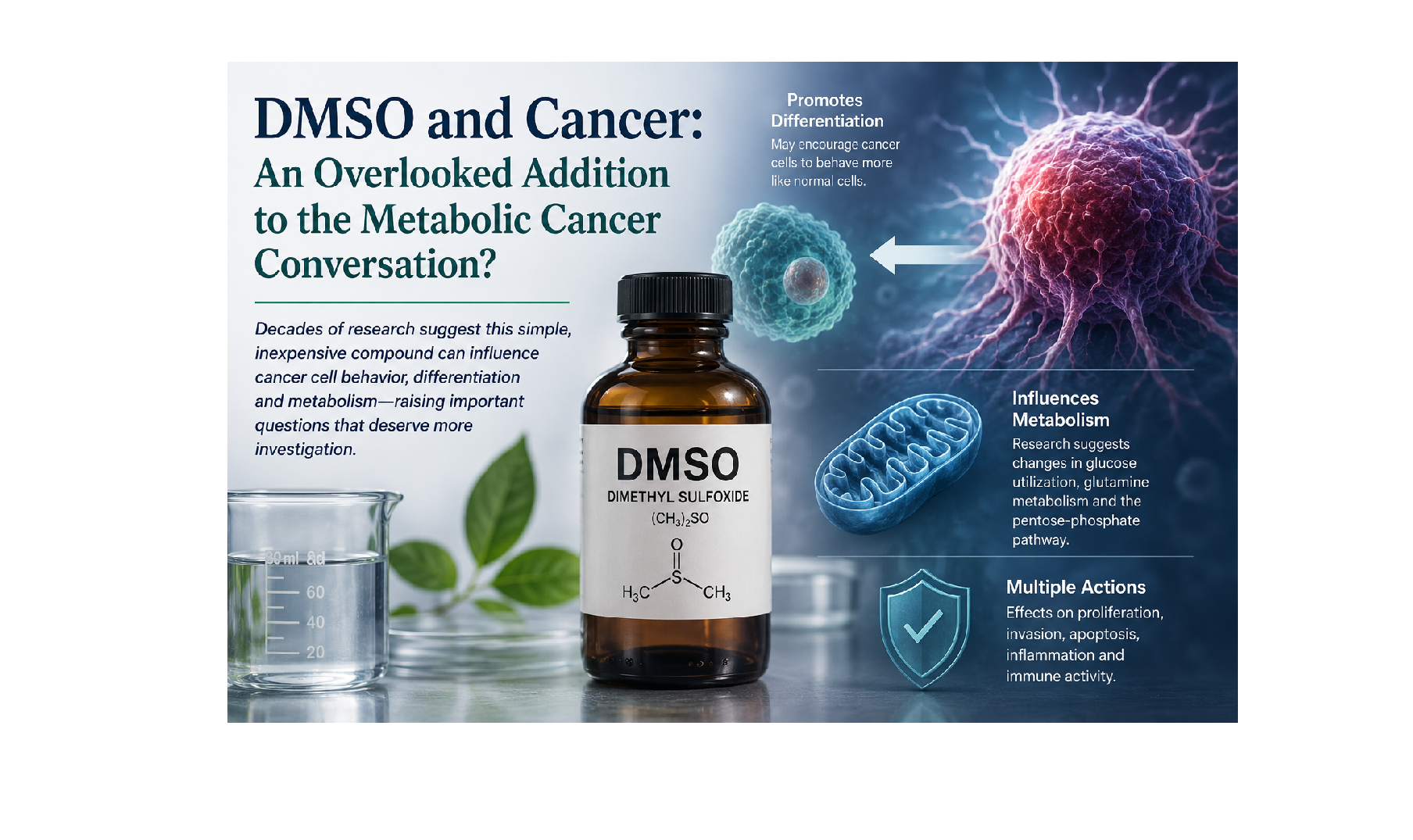
DMSO and Cancer: An Overlooked Addition to the Metabolic Cancer Conversation?
When most people hear of DMSO (dimethyl sulfoxide) they probably don’t think of cancer.
DMSO is a simple sulfur-containing compound that has been medically investigated for more than half a century. It readily penetrates biological membranes and has demonstrated anti-inflammatory, analgesic and free-radical-scavenging properties. A systematic review encompassing 109 human studies found that its adverse effects were predominantly mild and transient, although they increased with higher doses.
But buried within decades of scientific literature is something considerably more intriguing: DMSO can change the behavior of cancer cells.
Researchers have reported effects on cancer-cell differentiation, proliferation, invasion, apoptosis, immune activity and cellular metabolism. None of this establishes DMSO as a cancer cure. But it raises an important question:
Could this inexpensive compound have a useful role as one component of a multifaceted approach to cancer that has simply never been adequately investigated?
Making Cancer Cells Behave More Normally
Perhaps the most fascinating aspect of DMSO research involves cell differentiation.
Cancer cells frequently become “dedifferentiated,” losing many of the characteristics and regulatory mechanisms of the healthy cells from which they originated.
Decades ago, researchers discovered that DMSO could cause certain leukemia cells to mature into cells resembling normal, differentiated blood cells. Similar effects have subsequently been investigated in other experimental cancer models.
This is an important concept because instead of simply trying to kill a cancer cell, differentiation therapy attempts to push malignant cells toward more normal behavior.
That concept eventually became part of mainstream oncology, most successfully in acute promyelocytic leukemia, where differentiation therapy dramatically changed the prognosis of the disease.
DMSO has also inhibited proliferation, colony formation, migration and invasion in laboratory cancer models, while other experiments have demonstrated effects on apoptosis, the programmed cellular self-destruction mechanism cancer cells frequently learn to evade.
Where Does Metabolism Enter the Picture?
This is particularly interesting from HCCF’s perspective.
DMSO should not currently be described as a metabolic cancer therapy in the same category as fasting, therapeutic ketosis or interventions specifically targeting glucose and glutamine metabolism.
However, researchers studying leukemia cells undergoing DMSO-induced differentiation have documented changes in glucose utilization, glutamine metabolism and the pentose-phosphate pathway.
That does not prove that DMSO repairs damaged mitochondria or reverses the metabolic abnormalities associated with cancer. It does suggest, however, that when DMSO changes the malignant behavior of certain cancer cells, metabolic reprogramming appears to accompany that transformation.
A Remarkable Human Study
Perhaps the most compelling evidence comes from a largely forgotten 1993 study involving patients with advanced colon cancer.
Researchers conducted a prospective, randomized, double-blind controlled trial following palliative surgery. Among 193 fully evaluable patients followed for five years, the researchers reported that patients receiving either DMSO or allopurinol experienced a statistically significant survival advantage.
The investigators theorized that the free-radical-scavenging properties shared by the two substances might help explain the finding. A randomized controlled human trial showing a survival signal in advanced cancer is exactly the kind of finding that ordinarily should stimulate further research.
Why didn’t it?
Other Human Signals
DMSO has subsequently appeared in several very small human cancer studies. One involved 18 patients with metastatic prostate cancer receiving intravenous DMSO combined with sodium bicarbonate. Researchers reported improvements in symptoms, laboratory measures and quality of life during the study period.
Another involved nine patients with advanced unresectable biliary cancers receiving DMSO, sodium bicarbonate and S-adenosylmethionine. Researchers reported improvements in pain, biochemical measures and quality of life.
These studies are intriguing but should not be considered conclusive. They were small, lacked adequate control groups and combined DMSO with other substances, making it impossible to determine DMSO’s direct contribution, but they are results consistent with HCCF’s mission of educating the public on potential, effective treatments alternatives.
An Important Caution
DMSO should not simply be added indiscriminately to someone’s cancer protocol.
Researchers at the National Cancer Institute demonstrated that DMSO can chemically interact with platinum chemotherapy drugs—including cisplatin, carboplatin and oxaliplatin—and reduce their ability to damage cancer cells.
Other research suggests DMSO’s effects can vary substantially according to concentration and cancer type.
This reinforces an important principle of integrative cancer care, which is that more treatments do not necessarily mean better treatment. Integration requires an understanding of how therapies interact.
Why Hasn’t DMSO Been Studied More Extensively?
DMSO is inexpensive, widely available and difficult to turn into a highly proprietary pharmaceutical product, but developing a new cancer therapy through large clinical trials can cost enormous sums. Pharmaceutical companies can justify those investments when successful drugs have the potential to generate substantial returns. An inexpensive compound that has existed for generations presents a very different economic proposition.
Economic incentives alone have been shown to influence which answers to a particular medical condition receive the funding necessary to fully vet them.
What Does the Evidence Actually Justify?
In summary and as is typical, HCCF does not believe the evidence supports calling DMSO a cancer cure in itself. It also does not suggest that anyone should abandon proven cancer treatments or indiscriminately self-administer DMSO based solely upon laboratory studies or anecdotal reports. However, the absence of large, expensive modern clinical trials should not cause us to ignore decades of intriguing research that point to considering DMSO as an additional resource for healing from cancer.
