

The Missing Pieces in Cancer Healing: A Conversation Every Cancer Patient Should Hear
Every once in a while, I come across something that expresses the philosophy behind the Holistic Cancer Care Foundation so clearly that I simply want to say: “Please take the time to watch this.” This is one of those occasions.
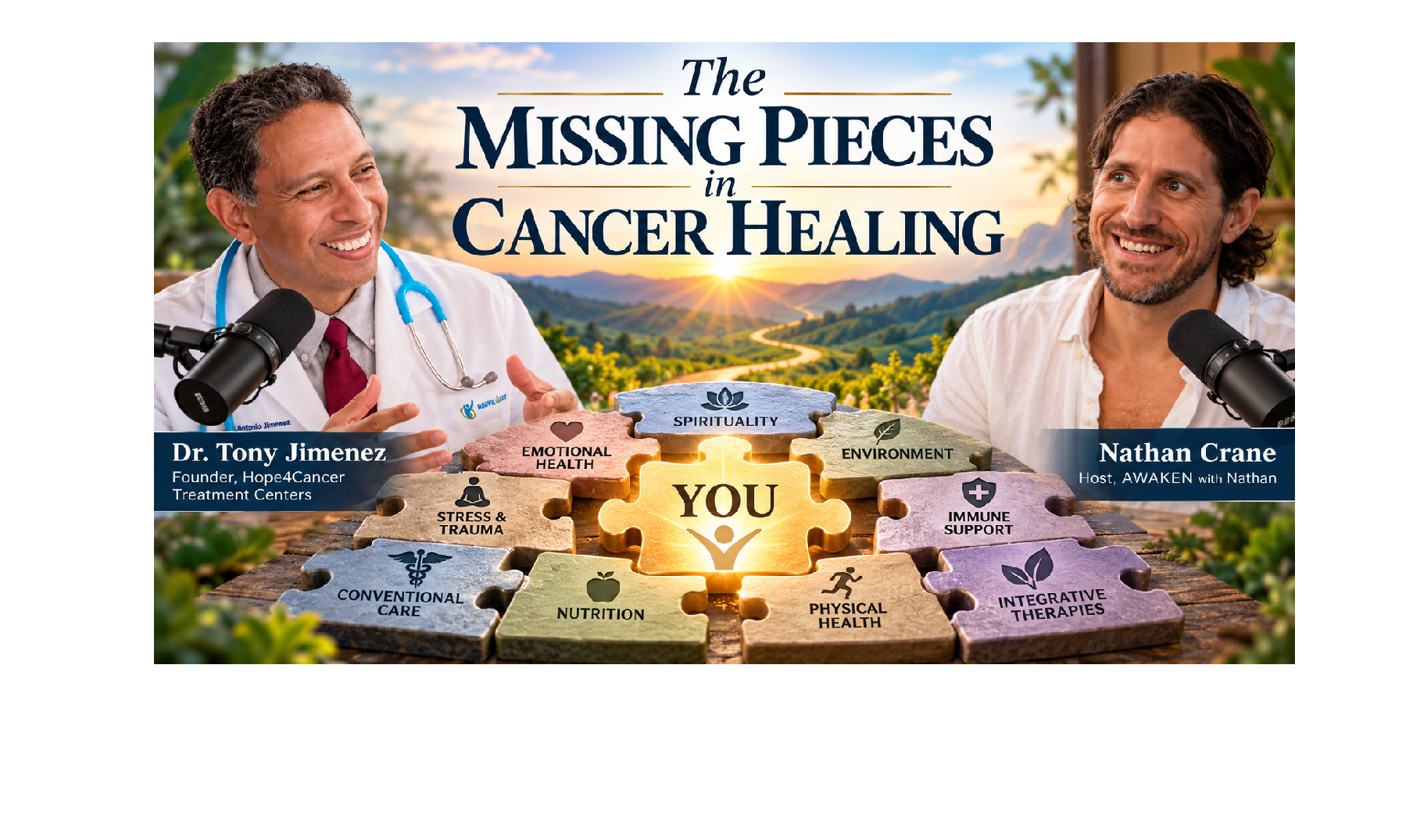
The video below is a conversation between Dr. Tony Jimenez, founder of Hope4Cancer Treatment Centers, and Nathan Crane, host of AWAKEN with Nathan. It is called “The Missing Pieces in Cancer Healing,” and the title could hardly be more appropriate.
It is also deeply personal for me. Both of these men played meaningful roles in my own journey through Stage IV cancer. More importantly, they helped reinforce an understanding that has become central to the mission of HCCF; cancer is extraordinarily complex, and healing should never be viewed through the narrow lens of simply attacking a tumor.
Modern oncology has developed increasingly sophisticated ways of attacking cancer cells—surgery, radiation, chemotherapy, immunotherapy and targeted therapies among them. These treatments can be enormously important and, in some circumstances, lifesaving, but there is another question that deserves far more attention: “What was happening within the body that allowed cancer to develop and progress in the first place?” And perhaps even more importantly: “What can we do to make the body a less hospitable environment for cancer and a more supportive environment for healing?”
Those questions are at the heart of the conversation in the video below. Dr. Jimenez discusses an integrative approach that looks beyond the tumor to the entire person—nutrition, immune function, environmental toxins, emotional health, unresolved trauma, stress, spirituality and the body’s own healing mechanisms. He also emphasizes something we believe strongly at HCCF; patients should become informed participants in their own healing rather than making decisions primarily from fear.
One of the most important lessons from my own experience with cancer is that I don’t believe there was a single “magic bullet” responsible for my recovery. The effective treatment of cancer demands a multifaceted approach to treatment. I used conventional oncology where I believed it could help me, but I also changed the metabolic environment of my body. I paid close attention to nutrition, exercise, sleep and stress. I explored promising therapies outside conventional standards of care. And perhaps most importantly, I refused to surrender my belief that healing was possible.
That last point is too easily dismissed. Hope is not a substitute for treatment. Positive thinking alone may not cure cancer. But neither should we underestimate the importance of the emotional and psychological environment in which healing takes place. A cancer diagnosis can immediately place a person into a world of fear. Fear of dying. Fear of treatment. Fear of making the wrong decision. Fear of what the next scan will show. Yet fear is a terrible place from which to make the most important decisions of your life.
One of HCCF’s central messages has therefore always been:
Get educated. Ask questions. Explore your options. Assemble the best combination of resources available to you. And never surrender hope.
A human being is not just a collection of independent parts. Nutrition affects metabolism. Exercise affects insulin sensitivity and immune function. Sleep affects hormones and immune regulation. Chronic stress affects the nervous and endocrine systems. Our environment affects what enters our bodies. Our relationships and emotional lives affect how we experience stress, fear and resilience.
If you or someone you love is facing cancer, I encourage you to set aside an hour and listen to this conversation. You don’t have to agree with everything that is said. In fact, you shouldn’t accept anyone’s views about cancer unquestioningly. As is pointed out in Kelly Truener’s book “Radical Remission”, following your own intuition is critical to recovery.
There are dimensions of your health over which you have considerable influence—what you eat, how you move, how you sleep, how you respond to stress, what environmental exposures you can reduce, the people with whom you surround yourself, the information you seek, and the mindset you bring to the journey. For me, that realization saved my life and became one of the reasons we created the Holistic Cancer Care Foundation.
Cancer may be one of the most frightening words anyone will ever hear. But a diagnosis does not mean that fear must dictate everything that follows. There is more to cancer treatment than treating the tumor. There is more to healing than medicine alone and there is always reason to embrace hope.
Please watch this important conversation between two people who have devoted much of their lives to changing the way we think about cancer and healing.
Watch: The Missing Piece in Cancer Healing | Dr. Tony Jimenez | AWAKEN with NATHAN
